
Coastal Operations in Uncertainty
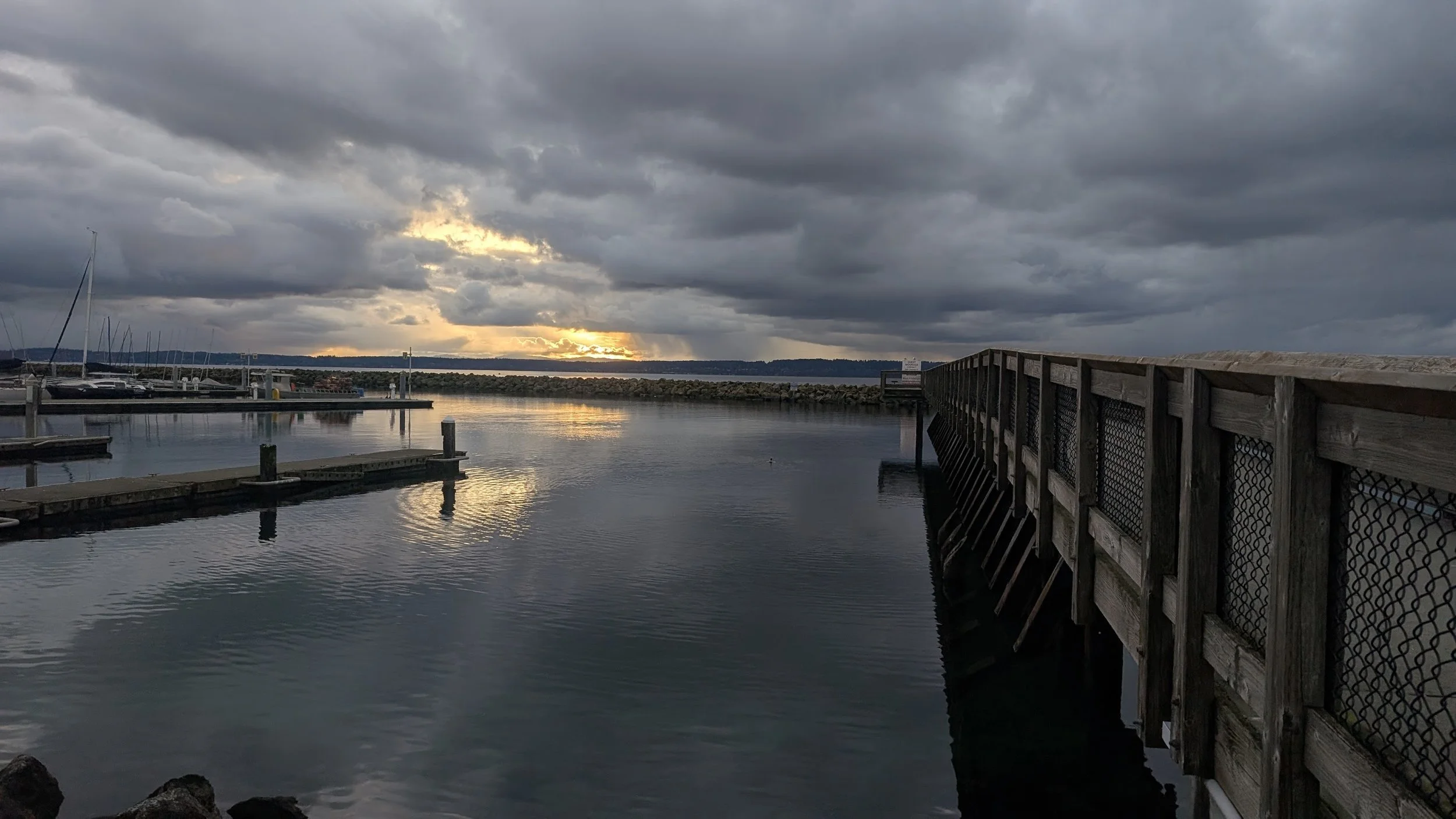
Puget Sound, Washington where 1.26 cubic miles flows through the 1,300+ mile coast every day.
At a recent conference this year in conversations with the Climate GPT initiative, tension kept surfacing from different angles. At the global level, we are building extraordinary capacity to observe Earth. Satellite constellations are imaging the entire planet daily. LLMs are being trained on vast climate datasets; the ambition is a unified environmental intelligence system that can synthesize carbon flows, methane emissions, ocean chemistry, and ecosystem health into something approaching a real-time picture of planetary conditions.
That ambition is necessary and worth pursuing. But it also reveals a gap that doesn’t get enough attention: the distance between global observation and local operational reality.
Thanks for reading! Subscribe for free to receive new posts and support my work.
The global environmental monitoring system operates with roughly a five-to-seven year lag when it comes to verified, actionable climate data. We can measure atmospheric carbon in near-real-time, but when it comes to understanding what’s happening at the local level, in a specific estuary, along a particular stretch of coastline, within the water column where shellfish are growing, the picture is patchy, delayed, and often stitched together from incompatible sources.
Governments and agencies are producing broad, low-resolution maps. They have to. Their mandate is regional and national scale assessment, and their budgets and methodologies reflect that. NOAA, the EPA, and their international equivalents do essential work, but the outputs are designed for policy and regulatory frameworks, not for the person standing on a dock trying to decide whether conditions are right to deploy seed, or the port commissioner evaluating whether a new aquaculture lease will conflict with water quality trends in a specific zone.
That resolution mismatch is the problem. And it’s getting worse, not better, as environmental volatility accelerates.
What the Data Gap Actually Costs
For a shellfish farmer, environmental conditions are the business. Ocean acidification affects shell formation. Salinity shifts stress juvenile stock. Harmful algal blooms can wipe out a harvest or trigger regulatory closures with little warning. Temperature trends over a season determine growth rates and mortality. Most operations are working with some combination of NOAA forecasts, periodic state agency sampling, their own thermometers, and intuition built over years on the water. The decision to harvest now or wait two weeks could be $100,000 won or lost.
That intuition is valuable and irreplaceable. But it doesn’t scale, it’s difficult to pass on, and it can’t account for the accelerating pace of environmental change that’s making historical patterns less reliable. There’s greater volatility and growing uncertainty about what’s coming and how to predict it. The farmer who could read the water twenty years ago is now seeing conditions that fall outside the range of anything they’ve experienced.
For port authorities and resource managers, the challenge is different but related. They’re balancing competing uses across a shared waterway: commercial shipping, aquaculture leases, recreational access, habitat conservation, water quality compliance. Each of those constituencies has different information needs, and the data that informs decisions is often siloed across agencies, collected on different schedules, and reported in formats that don’t talk to each other. A port commissioner trying to evaluate whether a new lease application makes sense given current and projected conditions is often working with an incomplete mosaic rather than a coherent picture.
The cost of this gap isn’t dramatic. It’s erosive. It shows up as avoidable crop losses, delayed regulatory responses, missed early warnings, and decisions made with less confidence than they should be. Over time, it compounds.
The Resolution Problem
The core issue, stated plainly: governments build and fund environmental systems at the scale of policy. Operators need environmental intelligence at the scale of decisions.
A national water quality assessment might tell you that conditions in a region are within acceptable parameters. But “the region” might span hundreds of miles of coastline with radically different local conditions. The estuary where you farm oysters might be experiencing pH swings that the regional average completely obscures. The bay where a port authority manages competing uses might have localized pollution inputs that don’t register at the scale the state agency is monitoring.
This isn’t a failure of government agencies. It’s a structural mismatch between the scale at which monitoring is funded and the scale at which decisions actually happen. Agencies are doing what they can with what they have, and their broad-scale work provides essential context. But the last mile of environmental data, the high-resolution, location-specific, operationally relevant layer, is largely unbuilt.
And this resolution gap is about to matter a lot more. The scientific consensus as of late 2025 is that overshooting 1.5C of warming is now unavoidable. The UNEP Emissions Gap Report projects that the world will exceed 1.5C within this decade, and even under the most aggressive mitigation scenarios, we’re looking at multiple decades above that threshold before any possible return. The best case modeled by Climate Analytics involves limiting overshoot to around 0.3C and returning below 1.5C by 2100. That’s the optimistic version. Current policy trajectories point toward 2.3 to 2.5C by end of century.
What this means for coastal operations is not abstract. The environmental baselines that existing models, management plans, and farming practices are built on are going to shift, in many cases faster than historical experience can account for. Ocean acidification, thermal stress, shifting species ranges, altered storm patterns, changing precipitation and salinity regimes: these are not future hypotheticals. They are the operating conditions for the next several decades at minimum, and the people making daily decisions in these environments need intelligence systems that can keep pace with that rate of change. Food production, coastal infrastructure, and ecosystem stability all depend on it.
The conversations about Climate GPT and planetary-scale Earth observation are exciting precisely because they point toward a future where global data infrastructure is radically more capable. But that capability flows downward. It needs to reach the farmer, the harbor master, the coastal planner. And the gap between “we can image the whole planet daily” and “I know what’s happening in my water right now” is not going to close automatically. It requires intentional investment in local-scale monitoring, integration, and interpretation.
Data Collection Is Not Intelligence
This brings me to what I think is the most underappreciated aspect of the problem. Even where data exists, having it is not the same as being able to use it. Sensors give you measurements. A dashboard gives you a display. But intelligence is a system, and the distinction matters.
The intelligence cycle looks like this. You collect data from the environment. You map it, placing it in spatial and temporal context so it means something beyond a number on a screen. You analyze it, identifying patterns, anomalies, and trends that matter for your specific operation. You forecast, projecting conditions forward so you can act ahead of problems rather than react to them. And then, critically, you adjust your acquisition strategy based on what you’ve learned. Maybe you need higher-frequency sampling in a particular zone because the analysis revealed unexpected variability. Maybe a sensor placement that made sense two years ago is no longer capturing the conditions that matter most.
The system isn’t static. It learns and adapts, and each pass through the cycle makes the next one more valuable. That feedback loop, where the outputs of analysis inform what gets measured next, is what separates monitoring from intelligence.
Most coastal operations today are stuck at the first step. They have some data, often from multiple disconnected sources, but lack the mapping, analysis, and forecasting layers that would make it actionable. Almost nobody is closing the loop by using analytical outputs to refine what gets measured next. That’s where the real value lives, and that’s what needs to be built.
What Could Happen
The good news is that the building blocks exist. Sensor costs have dropped dramatically. Satellite resolution and revisit rates continue to improve. Distributed sensor networks like Purple Air for air quality and Safecast for radiation have demonstrated that community-operated monitoring can produce reliable, high-frequency data at a fraction of centralized agency costs. Large language models are genuinely useful for synthesis, helping non-technical users query complex multi-source environmental data in natural language and get answers contextualized to their situation.
The challenge is integration. Getting satellite observations, in-situ measurements, agency data, and operator-reported observations into a common framework where they can be compared, cross-validated, and analyzed together is where the hard work is. It’s a systems design problem, and it requires people who understand both the technology and the operational realities of the communities that need this information.
For most coastal locations, there’s more existing data available than people realize. The gap isn’t in the raw existence of information. It’s in access, integration, and interpretation. Bridging that gap, building the local intelligence layer that connects global observation capacity to operational decision-making, is the infrastructure challenge of coastal climate resilience.
Why This Matters Beyond the Farm
There’s a broader story here about why local environmental intelligence is critical infrastructure, not just a nice-to-have for individual operations. It connects to how we build carbon markets that actually work, how we design coastal resilience plans grounded in real conditions rather than projections, how we develop insurance products that reflect actual risk, and how communities govern shared resources democratically when they can see what’s happening in their own environment. I’ll be writing about each of those in upcoming posts.
But the foundation for all of it is the same: you cannot manage what you cannot measure, and you cannot measure effectively if the data is fragmented, delayed, and disconnected from the people who need it most.
The shellfish farmer who can see environmental trends in real-time makes better harvest decisions and loses less stock. The port commissioner with integrated environmental context makes better leasing and planning decisions. The resource manager with a clear picture of water quality trends can act proactively rather than reactively. Each of those individual improvements is valuable on its own terms. Taken together, they start to build something larger: a coastal intelligence layer that makes entire regions more resilient, more productive, and better equipped to navigate the environmental volatility that’s already here and accelerating.
That layer doesn’t exist yet at the scale it needs to. Building it is the work.
